

TL;DR: Choosing by Workflow, Not Just Parameter Count
If you are deciding between MAGI-2 (480B Flagship) and MAGI-2-Preview (114B Apache 2.0), the clearest way to evaluate them is workflow by workflow:
- Text-to-Video: Preview handles basic 10-second single shots at 12.5 fps base; Flagship directs 4–30 second 1080p / 25 fps multi-shot scenes with timestamped hard cuts and synchronized dialogue.
- Image-to-Video: Preview upscales via a blind two-stage
magi2_refiner; Flagship uses a reference-aware 1080p latent upscaler that re-reads your source frame (opening near ~1163 Elo on I2V with audio). - Reference-to-Video: Unavailable in Preview; Flagship unlocks Omni-Reference conditioning (up to 10 images + 5 videos in the MG-2 AI Video Generator, and up to 20 multimodal items natively).
- Open-Weight Self-Hosting: Preview is Apache 2.0 today (~274–328+ GiB disk; 8× Hopper reference or 96 GB NVFP4); Flagship is cloud/API-first while its announced open weights are pending.
Side-by-Side Technical Comparison
| Feature / Metric | MAGI-2-Preview (Aug 2026) | MAGI-2 Flagship (Nov 24, 2026) | Workflow Impact |
|---|---|---|---|
| Total / Active Parameters | ~114B / ~6B active (~5.8%) | 480B / ~28B active (~5.8%) | >4× parameter capacity, >4.5× active compute per token |
| MoE Architecture | Single-stream Transformer + Multi-Head Latent MoE | Scaled Multi-Head Latent MoE (MagiMoE) | Constant cross-GPU communication; ~22% faster training vs single-head |
| Pre-Training Scale | 1× baseline | ~4T tokens (~1B samples, ~3× data) | Unfiltered crowds, fast pans, text & dense audio fix structural defects |
| Video Arena v2.1 (4-Task Avg) | 998.5 Elo | 1150.3 Elo (+151.8 Elo) | ~70.6% pairwise preference win rate over Preview |
| Higgsfield Arena (Nov 24) | Research tier | #2 Overall (1146 BT · 60.5% win) | Beats Seedance 2.0 (71%), Wan 3.0 (79%), Kling 4.0 (83%), MiniMax H3 (83%) |
| Clip Duration | Fixed 10 s | Flexible 4–30 s | Complete hooks, demos, and multi-beat scenes in one render |
| Resolution & Frame Rate | 272p / 540p @ 12.5 fps → magi2_refiner | Native 1080p @ 25 fps (reference-aware upscaler) | 2× temporal smoothness + sharper faces, text, and micro-textures |
| Aspect Ratios | Preview presets | All 6 ratios (16:9, 21:9, 4:3, 1:1, 3:4, 9:16) | Direct cinema-scope (21:9) and vertical social (9:16) on MG-2 |
| Native Audio | Unified 44.1 kHz stereo (stable-audio-open-1.0) | Synchronized lip-sync dialogue, foley, ambience & score | Tight acoustic perspective across camera changes |
| Text-to-Video | Single-shot 10 s | Multi-shot timeline hard cuts (up to 15 in 30 s) | Direct full edited sequences from a timed script |
| Image-to-Video | Single first frame | First/last keyframes + reference-aware 1080p upscaling | ~1163 Elo peak on I2V with audio; minimal face/logo drift |
| Reference-to-Video | Not supported | Up to 20 assets natively (10 img + 5 vid on MG-2) | Consistent characters, products, sets & motion across cuts |
| License & Availability | Apache 2.0 (sand-ai/MAGI-2-preview on HF) | Cloud & API live; open weights announced | Preview for local R&D; Flagship for production |
| Compute / Cloud Cost | ~274–328+ GiB disk; 8× Hopper ref / 96 GB NVFP4 | $0.08/s official API · 2.8 credits/s on MG-2 | ~84% lower 1080p cost than Seedance 2.5, zero GPU ops |
Workflow-by-Workflow Breakdown: Preview vs. Flagship
Every creative team uses video models differently. Below is how the 114B → 480B jump actually behaves across the three core production pipelines on MG-2.
1. Text-to-Video: From 10-Second Single Clip to 30-Second Directed Edit
On MAGI-2-Preview, Text-to-Video generates a single 10-second shot at 12.5 fps before passing through magi2_refiner. Pushing complex multi-beat storytelling or spoken dialogue into 6B active parameters frequently causes tempo drift or softened facial features.
On MAGI-2 Flagship (try it in the MG-2 AI Video Generator), the 480B backbone treats your prompt like a director's edit sheet. You can schedule explicit second-level hard cuts—up to 15 timed shots in 30 seconds—while keeping color grade, lighting continuity, and 25 fps motion locked across every cut.
Copy-Paste 30-Second Multi-Cut Prompt (Flagship Only):
30 seconds, 21:9 anamorphic, warm tungsten workshop lighting, shallow 85mm depth of field.
0–10s: Extreme macro tracking shot across tiny brass watch gears turning smoothly inside a mechanical caliber; crisp metallic ticking and faint workshop clock ambience.
10–20s: Hard cut to a medium close-up of an elderly Swiss watchmaker peering through a brass loupe, holding micro-tweezers steady. He sets a ruby jewel into place and murmurs softly in calm English: "Patience is the only tool that never wears out." Accurate lip-sync, subtle warm reflections on the loupe glass.
20–30s: Hard cut to a slow dolly pull-back across the oak workbench revealing golden late-afternoon sunbeams slicing through dust motes, finished wristwatch resting on velvet beside leather blueprints; ticking blends into a soft cello harmonic.
2. Image-to-Video: Why Flagship Opened Near ~1163 Elo
In MAGI-2-Preview, Image-to-Video conditions the 272p/540p base denoiser on your start frame, then hands the low-resolution result to magi2_refiner. Because the refiner never sees your original crisp image, small faces, product labels, and jewelry textures often lose fidelity during upscaling.
In MAGI-2 Flagship (live in the MG-2 AI Video Generator), the 1080p latent upscaler is reference-aware—it directly re-reads your uploaded image while synthesizing 1080p detail. Combined with RL post-training dedicated to lighting depth, skin pores, fabric weave, and fur physics (made possible because the 4T-token corpus already solved most anatomy defects during pre-training), I2V with native audio became MAGI-2's highest-scoring benchmark track.
3. Reference-to-Video: Entirely Absent in Preview
MAGI-2-Preview has no multi-asset reference mode. MAGI-2 Flagship introduces Omni-Reference conditioning—supporting up to 20 multimodal items natively, and up to 10 reference images + 5 reference videos inside the MG-2 AI Video Generator across all 6 native aspect ratios (16:9, 21:9, 4:3, 1:1, 3:4, 9:16).
That unlocks workflows impossible in Preview:
- Locking a recurring protagonist across wide, medium, and close-up cuts
- Keeping exact SKU packaging readable inside a 30-second commercial
- Transferring real camera motion or actor blocking from a reference video without paying extra credits for the uploaded reference clip's duration
Understanding the Benchmark Gap (+151.8 Elo) & Emergent Trade-Offs
Under standard Elo math (1 / (1 + 10^(-151.8 / 400))), +151.8 Elo equals a ~70.6% head-to-head human preference win rate. In the Nov 24, 2026 Higgsfield Video Arena blind ranking, MAGI-2 Flagship also earned #2 overall (1146 Bradley-Terry, 60.5% overall win rate).
A Note on Emergent Capabilities vs. Post-Training Craft
During 480B pre-training on 4 trillion unfiltered tokens, the raw checkpoint (without prompt rewriting) displayed intriguing general-purpose behaviors—visually completing a 9×9 Sudoku grid, planning multi-angle coverage from sparse instructions, and translating spoken dialogue across languages. Once aesthetic RL post-training is applied to polish lighting, skin, and materials for production users, those raw reasoning behaviors become harder to trigger reliably. Knowing that distinction helps researchers understand why raw pre-training benchmarks and commercial RL checkpoints behave slightly differently.
Deployment Architecture: Self-Hosting Preview vs. Cloud Studio on MG-2
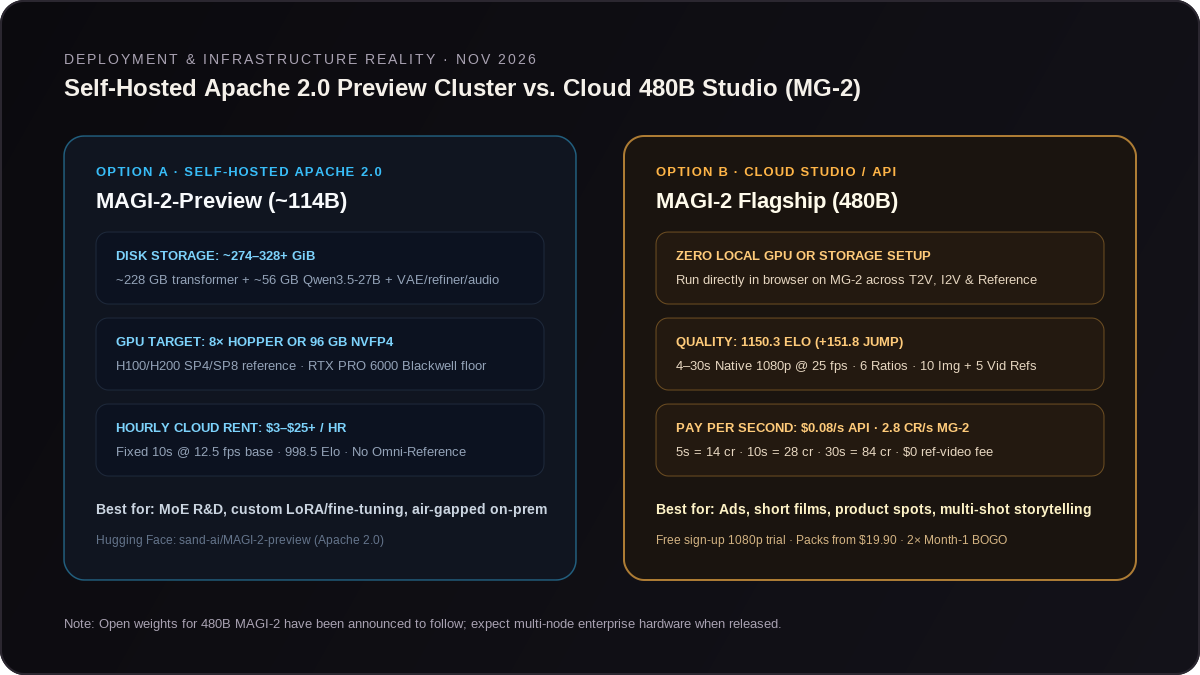
What Local / On-Premise MAGI-2-preview Actually Demands
Downloading sand-ai/MAGI-2-preview (Apache 2.0) is straightforward; provisioning the compute to run it is not:
- Disk allocation: ~274–328+ GiB (~228 GB video transformer + ~56 GB
Qwen/Qwen3.5-27Bencoder + VAE,magi2_refiner, andstable-audio-open-1.0audio module). - Reference multi-GPU hardware: 8× NVIDIA Hopper (H100/H200) or 4-GPU resident sequence-parallel (SP4) nodes via containerized stacks or vLLM-Omni.
- Quantized single-GPU floor: Community NVFP4 builds squeeze inference onto a single card, but still require roughly 96 GB VRAM (e.g., NVIDIA RTX PRO 6000 Blackwell)—out of reach for 16–24 GB consumer GPUs.
Real-World Cost Comparison (1080p + Synchronized Audio)
| Clip Duration | Official MAGI-2 API ($0.08/s) | MG-2 Credits (2.8 credits/s) | Self-Hosted MAGI-2-preview |
|---|---|---|---|
| 4 seconds (Free Trial / Short Hook) | $0.32 | 12 credits (free sign-up trial available) | Fixed 10s pipeline; hourly GPU billing |
| 5 seconds | $0.40 | 14 credits | Fixed 10s pipeline; hourly GPU billing |
| 10 seconds | $0.80 | 28 credits | 4×–8× Hopper or 96 GB GPU rental ($3–$25+/hr) |
| 30 seconds | $2.40 | 84 credits | Not supported natively (10s cap) |
| 10s Ref Video → 10s Output | Output seconds only | 28 credits ($0 ref-video fee) | Not supported (no Reference-to-Video) |
On MG-2 Pricing, non-expiring credit packs begin at $19.90 (200 credits), monthly subscriptions include 2× credits in month one (buy one, get one free for new subscribers), and annual plans deliver the entire year's credits upfront.
Quick Decision Framework
- You want publish-ready 1080p / 25 fps video across all 6 native aspect ratios.
- You need 4–30s multi-shot scenes, crisp I2V fidelity, or Reference-to-Video asset locking.
- You want zero GPU DevOps and transparent per-second credit math (2.8 cr/s on MG-2).
- You need downloadable Apache 2.0 weights today for research, custom fine-tuning, or quantization.
- Security policy requires air-gapped on-premise inference with no external API calls.
- You already manage 4×–8× Hopper clusters or 96 GB Blackwell workstations.
Known Limitations to Plan Around (Even on 480B)
- Extreme high-speed motion: Whip pans, rapid combat flurries, and chaotic debris can still trigger brief continuity artifacts—isolate one clear subject per fast beat.
- Medium/wide 2D animation: Secondary motion in medium and wide hand-drawn anime shots can appear slightly over-smoothed compared to close-ups.
- Dense multi-layered audio: Dialogue and primary foley hold up cleanly, while complex overlapping soundscapes (crowded arenas + full score) still benefit from light broadcast post-mixing.
- 480B open weights pending: Local-only flagship deployments must wait for the follow-up open-weight drop.
Frequently Asked Questions
What changed between MAGI-2-Preview and the full MAGI-2 model?
MAGI-2-Preview (August 2026) is an ~114B (~6B active) Apache 2.0 research checkpoint capped at 10-second 12.5 fps base clips and basic T2V/I2V. MAGI-2 Flagship (November 24, 2026) scales to 480B total (~28B active) on 4T tokens, raising Video Arena v2.1 from 998.5 to 1150.3 Elo (+151.8) and adding 4–30s native 1080p/25fps video, 6 aspect ratios, 20-asset references, and timestamped hard cuts.
Which MAGI-2 workflow sees the biggest quality jump over Preview?
Image-to-Video and Reference-to-Video deliver the steepest leap. Flagship MAGI-2 opened near ~1163 Elo on dedicated I2V with audio because its reference-aware 1080p latent upscaler re-reads source frames directly instead of relying on a blind refiner.
Does MAGI-2-Preview support Reference-to-Video workflows?
No. Preview supports only text-to-video and single first-frame image-to-video. Multi-asset Reference-to-Video (up to 10 images + 5 videos on MG-2) is exclusive to the 480B flagship.
Can MAGI-2-Preview generate 21:9 cinema or 9:16 vertical 30-second videos?
No. Preview is capped at fixed 10-second clips at 12.5 fps base. Full MAGI-2 generates 4–30 second clips at 25 fps across all 6 native ratios (16:9, 21:9, 4:3, 1:1, 3:4, 9:16).
How much VRAM and disk space does self-hosting MAGI-2-Preview require?
Plan for ~274–328+ GiB of disk storage (~228 GB transformer + ~56 GB Qwen3.5-27B text encoder + VAE/refiner/audio). Official scripts target 8× Hopper or 4-GPU sequence-parallel nodes; community NVFP4 quantized builds still need roughly 96 GB VRAM (such as an RTX PRO 6000 Blackwell).
How does MG-2 price MAGI-2 1080p video across T2V, I2V, and Reference-to-Video?
MG-2 prices MAGI-2 1080p uniformly at 2.8 credits per output second (14 credits for 5s, 28 for 10s, 84 for 30s) with zero surcharge for reference-video input seconds. New users can sign up free (no credit card) to test 1080p video with native sound.
Is the 480B MAGI-2 flagship open source yet?
Not yet. MAGI-2-preview is Apache 2.0 today; open weights and technical documentation for the 480B flagship have been announced to follow its initial cloud and API rollout.
How does MAGI-2 compare against Seedance 2.5, Wan 3.0, and Kling 4.0?
In the November 24, 2026 Higgsfield Video Arena blind evaluation, MAGI-2 Flagship ranked #2 overall (1146 Bradley-Terry, 60.5% overall win rate)—trailing only Seedance 2.5 (1219) while beating Seedance 2.0 (71%), Wan 3.0 (79%), Kling 4.0 (83%), and MiniMax H3 (83%) at roughly 84% lower 1080p cost than Seedance 2.5.
Launch Your MAGI-2 Workflow on MG-2
Run Text-to-Video, Image-to-Video, and 15-asset Reference-to-Video from one unified workspace—sign up free (no credit card required) to test 1080p native-audio generation in your browser:
- Open the MAGI-2 AI Video Generator — Direct 4–30s 1080p scenes with timestamped hard cuts, first/last frames, or up to 10 images + 5 reference videos across all 6 ratios (
16:9,21:9,4:3,1:1,3:4,9:16). - Explore MAGI-2 Overview & Demos — Inspect live 1080p native-audio showcase clips and architecture specs on the MG-2 home studio.
- Pricing & Credit Packs — Compare 2× first-month plans, upfront annual tiers, and $19.90 non-expiring packs at 2.8 credits/second.